Facility Management Staffing Crisis: How AI Helps Small Teams Run Large Buildings
Tariq Mahmoud
Mechanical Systems & Building Performance Consultant
The Facility Management Industry Faces a 20% Workforce Gap
Industry bodies highlight a significant FM workforce shortage globally, with many markets reporting double-digit gaps between demand and available technicians as experienced staff retire faster than new workers enter the field. In the GCC, regional FM market analyses identify the labor deficit as a primary restraint on sector growth. The average FM staff turnover cycle in the Gulf is approximately 3 years, meaning institutional knowledge of a building's quirks, failure patterns, and seasonal behaviors walks out the door on a regular rotation.
When Institutional Knowledge Lives in the System, Not the Person
In A.R.V.I.S.'s Marina Heights Tower simulation, we tested a specific scenario that mirrors what facility teams across Qatar experience regularly: a senior technician (Ahmed) had accumulated critical building-specific knowledge over years of operation, including a humidity-related cold-start pattern for Chiller-3. When outdoor relative humidity exceeded 75%, the unit required an extended pre-flush sequence, otherwise it short-cycled on startup and required a manual reset adding 90 minutes to the startup procedure.
This knowledge was not in any manual. It was not in the BMS. It lived in Ahmed's memory.
A new technician (Bilal) joined mid-simulation with no knowledge of this pattern. When outdoor humidity climbed to 78% and Bilal initiated a standard cold start on Chiller-3, A.R.V.I.S. intervened before the startup sequence completed, recalling Ahmed's documented pattern from operational memory and presenting Bilal with full context: "This chiller has a humidity-related cold-start requirement documented by Ahmed on March 4th after a failed startup. Recommended: use the extended pre-flush sequence. Confidence: confirmed across 3 prior incidents."
Without operational memory, Bilal completes the standard startup, triggers the manual reset, and spends 90 minutes diagnosing a pattern Ahmed understood in 30 seconds. More critically: if Bilal makes the same mistake 4 times before discovering the pattern, the pattern may never get documented at all.
How AI Multiplies Team Capacity
According to the U.S. Bureau of Labor Statistics (2024), the median facility technician is 48 years old, and 25% of the workforce will reach retirement age within 5 years. The knowledge they carry (seasonal patterns, equipment quirks, vendor preferences, failure histories) leaves with them unless the building has a system that captures and retains it.
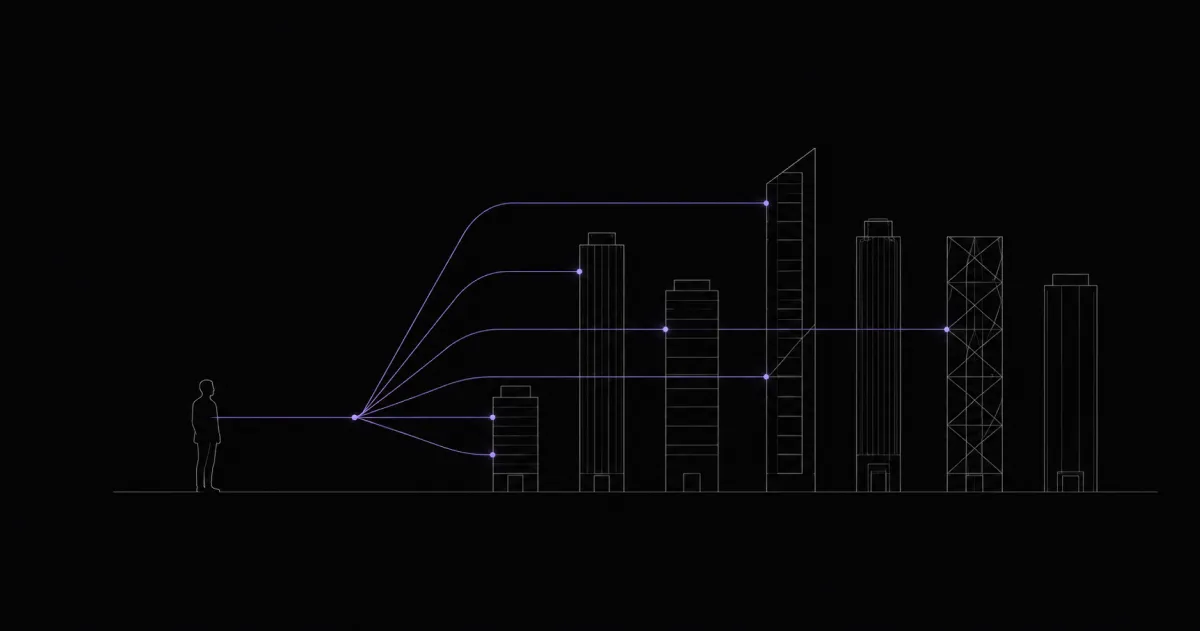
AI solves this in three ways:
- Continuous automated monitoring: The ABI engine watches every system 24/7, eliminating the need for manual inspection rounds that consume 30 to 40% of technician time.
- Instant root-cause diagnosis: Instead of spending 2 to 3 hours tracing an alarm cascade, the AI identifies the root cause in seconds and presents it in plain language.
- Operational memory: The AI remembers every fault, every resolution, every seasonal pattern, institutional knowledge that persists regardless of staff turnover.
Enabling New Technicians to Perform Like Experts
According to McKinsey (2023), AI-assisted workers in technical fields achieve expert-level task completion 40 to 60% faster than unassisted workers during their first year. For facility management, this means a technician with 6 months experience plus AI guidance can effectively manage systems that would traditionally require 5+ years of building-specific knowledge.
The AI does not replace the technician,it makes every technician more effective. One person with AI support can responsibly manage the operational complexity that previously required three people.
The facilities industry cannot solve the labor shortage by hiring alone. It must multiply the effectiveness of the team it has. Intelligent building systems are the multiplier.
Want to see how A.R.V.I.S. handles workforce augmentation in practice? Request a demo.
About the author
Tariq Mahmoud
Mechanical Systems & Building Performance Consultant
Tariq has advised on GSAS compliance and facility operations across Qatar and the UAE for over 18 years. He focuses on lifecycle energy reporting, operational sustainability, and the intersection of FM practice and Qatar Vision 2030 mandates.
Frequently Asked Questions
Related Insights

Why Smart Building Technology Is the Foundation of Smart Cities
Buildings account for 40% of global energy consumption. Smart cities emerge when individual buildings become intelligent grid participants, not from top-down infrastructure projects.

How to Cut Building Maintenance Costs with Predictive Analytics
Predictive maintenance reduces costs by 25 to 30% and downtime by 70 to 75% according to Deloitte. Learn how AI eliminates both calendar-based waste and reactive emergency repairs.